(03-03-2019)
Within the halls of an academic environment, I found myself unable to grasp the meaning of certain teachings—ineffable and unreachable, almost mystical, pervaded by a limitless beauty. All this beauty drew us in like a dream, yet upon waking, the practical reality ruined everything.
At times, I continue to wonder how it is possible for such ugliness to pass almost unnoticed, and whether we might one day restore an aesthetic quality that has seen such decay in architecture. We possess all this technology, yet we cling to history. Cathedrals were built in the Middle Ages, while here we are, scavenging for one color of plaster over another, perhaps to save a few pennies. We work ourselves into an exaltation over some inconsequential detail while observing contemporary architecture.
At this point, I declare: Architecture is dead; long live architecture. The tangible proof is found when facing a context that currently appears increasingly riddled with constraints. Especially in historical buildings, everything is restricted; nothing of the original conception can be changed, even if it were for a better version, because architecture is dead!
The assumption is that the modern era only knows how to create distortions; and how, after all, can we blame them? One only needs to look around. You of the 20th century ruined the landscape, devastated aesthetics, and now you presume to have a say on the past? Architecture is dead; cocktail party invitations are not enough to awaken wonder in bystanders toward the contemporary. Yours are empty words, as it is the facts that speak. You architects, deal with the new, but leave the old alone, because you do not know how to design, you do not understand aesthetics, you make a mockery of art, and you must not lay a hand on certain works. This is why architecture is dead. There would be much more to say, but for now, let us leave this topic for another time and address the design “sign” in architecture.
The Gaze Toward the Past
The gaze we turn to the past is a mandatory step in order to understand what we are about to do. Whether we wish to build a square, a villa, or a garden, the information and instructions we absorb from those who preceded us in these tasks remain—and will remain—invaluable for achieving an optimal result. Analyses of antecedent works are often conducted down to the smallest detail on the issues that interest us, precisely to gain the maximum advantage from the masters who have always inspired us.
The desire to deeply grasp the aspects of past architecture is rooted above all in the success of many of these works; they effectively concretize the intentions that gave them birth, creating those “poles of attraction” that have become true symbols—reference points for a city that adopts them, weaving them into the countless aspects of social life. This demonstrates the distinguished results achieved by architects who were able to transfer the very desires of mankind into masonry. Those same architects, in turn, took inspiration from others, just as we do today, despite the difference in historical periods.
The Roman Context
It seems, therefore, that the passage of time has not eroded the desire to live well; in Rome, this desire is even more evident in the historical vestiges that have always been the subject of study and analysis. Because of this, we find inspiration in the places that surround us today, feeling almost obligated to do so by a natural sense of attachment to the past and our origins. All the countless examples present in Rome—Piazza Navona, the Spanish Steps, the Pantheon, etc.—endure the onslaught of visitors, proving through the most concrete results the success of their design intentions. It is in these situations that the architect disappears and “man” appears, the work having reached its fulfillment.
In the same way, modern architects try to transfer their design directions into reality, taking care that these, too, are accepted as the aforementioned works were. However, situations arise that unfortunately often fail to find consensus among those who use them.
The Modern Failure
Despite the ideal will for a strong historical foothold, the contrasts that make these works repellent break that relationship between man, environment, and building. The ideas present—if there are any—seem incomprehensible, and the consequence lies in the unacceptable reality that faces us: the world of modern architecture fails to create that bond with history that is so sought after. Even though the modern architect holds those same intentions that motivated the ancients, and despite having neglected nothing in the search for links with the past, the results of modern architecture betray those desires. In this tragicomic outcome, an error eludes us; despite the refinement of the proposed projects, there transpires a superficiality of solutions that, while “sophisticated,” are not truly “sought after.”
Once again, the final aspect of this art leaves no room for theoretical discussion. The places created by the moderns—devoid of any mediation—are born and die in the mind of the creator without ever managing to find that bond with humanity and the past. These places are not capable of recreating the sensations we desire, nor do they interest us, as they seem to repel us.
In the simplicity of the ancient Stadium of Domitian (Piazza Navona), we find those ingredients that enhance the values of this urban landscape. The references that modern architecture gathers from its constituent elements dictate the principles of building, yet it seems they were not enough to reach the sought-after quality. This proves a fundamental misunderstanding in the study of a Square—a study that will help us find the errors of a modern approach to architecture, starting from its very perimeter.
Around this form, which has remained intact over time, a series of buildings and architectural elements have followed, standing out particularly for their artistic value. It was not, therefore, born from the idea of a single architect; the composition as a whole—its form—is not the offspring of a mind that decided at a drawing table that it should be as we find it today. It represents simply the outline of a stadium that the Romans used for their entertainment. Certainly, the buildings surrounding this mark are often the work of famous architects, but in the way we intend to design in modern architecture today, the “sign” of this space had no single creator.
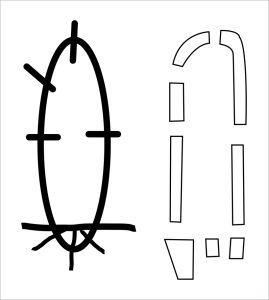
Piazza Navona — on the left, how the Square might look through the “architectural mark” of a single designer; on the right, how it exists in reality. The former did not serve to create the beauty of this work.
Its beauty, framed within this simple rectangular form, seems to mock the abstruse entanglements of extreme modernity; the idea of this place, which was not born from the hand of a single architect, can only be found within the square itself! And so, if such a form remains unexpressed in the mind, it is the place itself that expresses it.
This reflection does not provide a definitive answer to the unbridgeable gap left by a modern architecture that seeks to establish a similar harmony between man and the built environment. However, for the time being, it indicates that an unpretentious mark can reach heights where contemporary research—despite its great complexity—falls short in the fundamental requirements of living. Thus, a substantial contrast emerges, revealing two different approaches in the “mark” left behind, confirmed by the final effect. The planimetric entanglements that appear on paper thrill us, only to reveal themselves in reality in all their misery—gloomy and ravaged by time, which only increases their decay.
This is the result: simple, direct, and without excessive theorizing. You architects of the 20th century created this, and the fear of letting you touch the works of the past is entirely understandable. You do not grasp the importance of “mediation” in a work—that fundamental presence in all the elements that allow it to integrate perfectly into its context, not just physically, but above all socially, so that over time it becomes part of the life of the community that uses it. Thus, the previously expressed concepts of symmetry, height, geometric ratios, and, in this case, form, re-emerge.
© Arch. Alessandro Plini
www.archihouse.it
www.plini-leone.com
Contact for projects: studioarchihouse@gmail.com o plini.leone@gmail.com
Mob. +39 3496039795