(Symmetry in Architecture: is symmetry synonymous with beauty?)
(16-01-2019)
Symmetry is simply defined as a specular correspondence of parts relative to an axis or a center. In practice, this general definition can be compared to how a mirror reflects images. It is as if an ideal axis exists between us and the mirror; this axis represents the center of projection for the image. Imagine a semicircle and project it across its axis so that it forms a complete circle: we have thus obtained a symmetrical image.
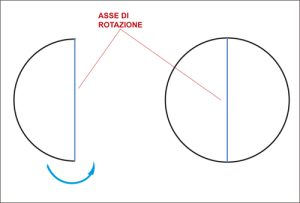
The rotation of the semicircle around the axis creates a figure symmetrical to it, and as such forms a circle.
Nature, in all its macro and micro aspects, is pervaded by examples of symmetrical structures that reflect extreme functionality, as nature pursues the least possible effort associated with the greatest resistance.
My approach will be to elaborate on symmetry in relation to construction aspects, highlighting in this brief article how symmetry—despite having purely functional characteristics—can align with the principles of aesthetics that determine whether a work is pleasing or not. It is simply a matter of utilizing this characteristic (symmetry) to سپس judge it within any given context, thereby giving it a universal architectural meaning.
So far, we have seen several elements that I consider fundamental to ‘good architecture.’ One was defining a project starting from the concept of use—meaning that a building will have a practical function and will be experienced by people for that function. Then, we examined proportions as the relationship between the whole and its parts, stating that excessively tall buildings, such as skyscrapers, may please or even fascinate us at times, but they cannot be part of ‘good architecture.’ Now, symmetry provides us with further analytical tools.
As we have seen, we have not discussed aesthetics—even though all of this will eventually become part of it—but rather simple geometries; without delving into the vast array of architectural choices each of us can make, we have established their relationship with humanity. Although these elements are not sufficient to exhaustively outline an ‘architecture of good living,’ they represent its foundation and, as such, embody the explicit manifestation of the relationship between ourselves and the space that surrounds us.
Symmetry is extremely functional; a body is symmetrical insofar as it holds and supports its own weight in the best possible way, making it stable. An asymmetrical body would be unstable and, as such, would lose its balance. The more symmetrical an element is, the more resistant it becomes: in a perfectly symmetrical building, its center of mass coincides with its center of stiffness. What does this mean? It means that if a violent horizontal force is applied (such as an earthquake), the forces will concentrate within its stiffness (all the load-bearing elements). Since this corresponds with the center of mass, the earthquake’s thrust will be supported by the entire structure; in other words, the entire structure will react as a single body to the acting stresses.
Conversely, in an asymmetrical body where the center of mass does not correspond to the center of stiffness, a dangerous torsional effect occurs. Some parts must bear the full force of the horizontal thrust while others remain uninvolved, leading to a consequent decay of total resistance and eventual collapse.
A vivid example is the building in the photo: during the 1923 Tokyo earthquake, which had a magnitude of 7.8, this old building remained standing. The perfect symmetry of its elements withstood what more modern buildings were unable to endure.
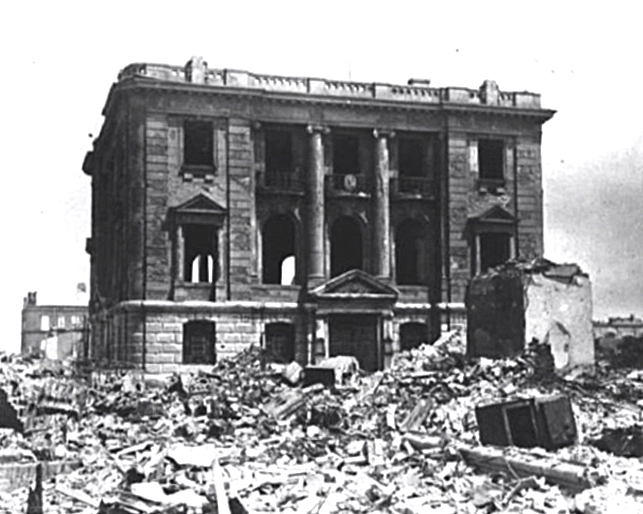
1923 Tokyo earthquake. Magnitude 7.8. Despite being an old building, the perfect symmetry of the building meant that all the earthquake’s horizontal forces were transferred vertically to the structure, avoiding dangerous torsional effects. This way, the structure remained intact.
Molecular bonds help us appreciate the effectiveness of a symmetrical structure even more. In aramid fibers, we observe the different crystalline arrangement of Nomex, which has bonds at the top between the hexagons and a modulus of resistance of 2,600,000 N/cm², compared to Kevlar—renowned for its extremely high strength—which has bonds centered between the hexagons and a modulus of resistance that can reach 15,000,000 N/cm². A simple geometric difference has practically revolutionized the field of these materials.
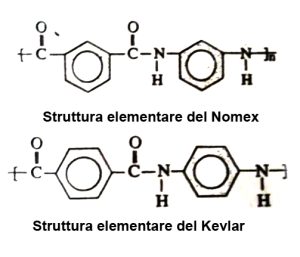
The symmetry of the bonds significantly increases the strength of the materials-
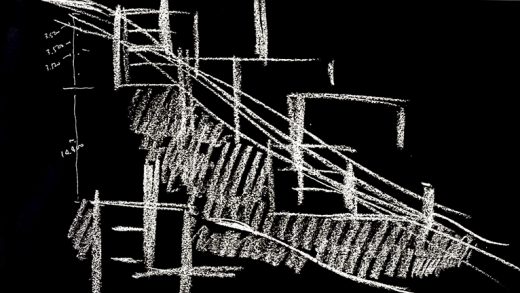
What we do when designing certain elements is to grant them a perfect symmetry, such that we can maintain control over both static and dynamic effects. Simple stairs connecting a residential building to its various floors will hardly ever be rendered asymmetrically, for both functional and aesthetic reasons; it is easy to observe in the figure the dissonance that such a result could entail. This signifies that symmetry follows every stage of our creative process and is integrated into all construction elements.
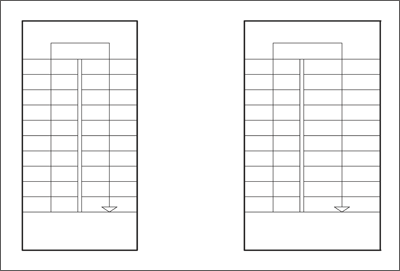
Simmetria e asimmetria delle scale
Running by distributing body weight symmetrically across the legs leads to increased endurance; an irregular effort inflames the muscles, puts abnormal stress on the bones, and shortly thereafter, we would be forced to stop due to severe pain. There are many such examples around us and they are easy to observe; from this, we can deduce that symmetry is an essential aspect of our lives and possesses a fundamental functional value. But does it also have an aesthetic value? In other words, is a symmetrical body consequently ‘beautiful’?
Actually, this was not the ultimate goal of this article. For me, it is not essential to formulate a thesis to verify the coexistence of a symmetrical relationship with its potential fascination. A work that is symmetrical in all its parts will likely appear pleasing to our eyes; we can therefore admit that this is part of its aesthetic quality. However, as stated at the beginning, let us try to make our answers as objective as possible. We may not always succeed, but the attempt remains.
Stepping away from purely aesthetic judgments, let us compare two antithetical solutions—one symmetrical and the other asymmetrical—through a simple graphic representation. At this point, let us ask ourselves the right question: the question is not which one is the most beautiful, but rather, given the same environmental conditions, which one would you choose to live in?
In the figure below, let us place the silhouettes of three buildings designed according to the themes discussed so far. Let us draw a skyscraper, a perfectly symmetrical building, and one that is asymmetrical in all its parts. Let us imagine them in the same neighborhood—perhaps a semi-central area with all the necessary services, gardens, clean streets, and excellent public transport. Now, if we were told to choose, on impulse, which of the three we would want to live in, which would you choose?
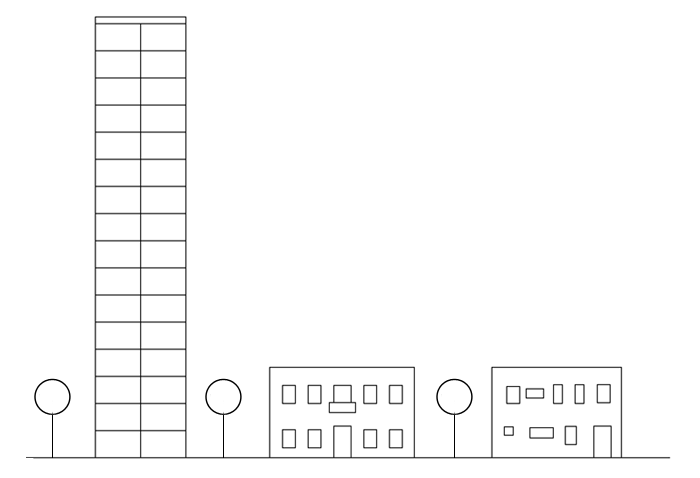
The choice will most likely fall upon the perfectly symmetrical building; thus, we have unconsciously assigned it an aesthetic value as well. Symmetry, therefore, if not beauty itself, is something that belongs to it. Its stability—which arises from its very conformation—is reflected in the structures, acquiring that sought-after sense of security that draws us closer to its forms, making them more attractive. Symmetrical as a synonym for secure: we desire it, we want it; inseparable, it is part of our very nature.
Something symmetrical is judged by many to be beautiful as well, but that alone is not enough. To achieve the desired result, it is necessary for all its (symmetrical) parts to be in a harmonic relationship, like the notes of a melody; its asymmetries, which are nonetheless present, should be like tonal accents or dissonances that elevate its value rather than diminish it.
In a building, we can organize every part to be the mirror of another, achieving perfect symmetry, or we can ignore these concepts by developing figurative asymmetries to the extreme of a sought-after originality. However, we must always account for the surrounding reality and how it is and will be perceived, since—as already explained—architecture has a purpose that transcends mere aesthetic-conceptual notions.
© Arch. Alessandro Plini
www.archihouse.it
www.plini-leone.com
Contact for projects: studioarchihouse@gmail.com o plini.leone@gmail.com
Mob. +39 3496039795