(23-11-2018)
Measurements, proportions, and symmetries translate to our senses an image that, without such control, would lose direct contact with the very being who inspired its concept and study: Man.
Proportions, therefore, are not limited to merely guiding our sight in a regular fashion or directing us toward the composition of a building; they are an essential tool for controlling the entire design process. In the following sections, while discussing proportions, I will attempt to demonstrate how they possess an aesthetic value—one that is unfortunately overshadowed today by the “spectacularization” of the built environment. This modern trend subordinates harmony, almost relegating it to ancient manuscripts, and transfigures architecture into a mere playground for trendy “verticalists” and “weavers.”
Proportions are a means, certainly not the end (as defined in other discussions), but without them, it would be impossible to construct or realize an architecturally acceptable building. To escape their rules would lead us to results no different from the drawings of a child.
Why are proportions so important and fundamental?
They have captured the interest of the greatest scholars of all time. We need only think of Pythagoras; the mathematician and philosopher is credited with discovering the interaction between music and numbers, made evident by simple ratios: 1:2, 1:3, 1:4, 2:3, 3:4. How are these ratios born?
Take, for example, a vibrating string (like a guitar string) and let n be its measurement. Under the same conditions (i.e., with the same tension applied), another string measuring half of it, or “1/2 n”, will vibrate at a sound one octave higher (diapason); thus, we have defined the ratio of 1:2.
If, instead, the shorter string is 2/3 of the long one, the difference in sound will be a fifth (diapente – 2:3); if it is shorter by a ratio of 3/4, the difference in tone will be a fourth (diatessaron – 3:4). This is how music binds itself to mathematics and geometry. By applying these simple ratios in design, we substantially link the various arts, where architecture transforms something intangible like music and renders it into stone.
This is a connection between the arts quite different from the one seen in a previous article regarding twentieth-century artists, where the encounter between sculpture and painting, for example, could be asserted simply by slashing a canvas at will.
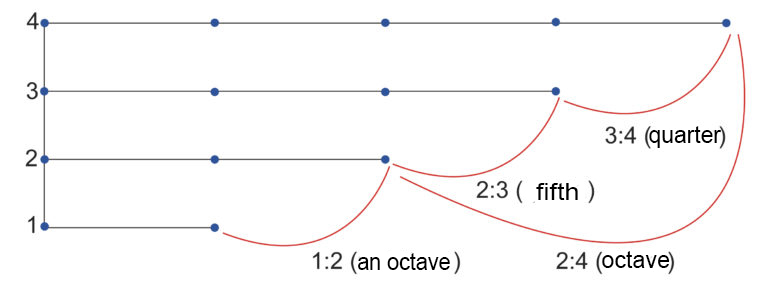
– The relationship between mathematical ratios and musical tones is clear –
In the analysis of the well-known Golden Ratio, we find equally interesting deductions. Discovered in Ancient Greece and represented by the letter Φ [phi], it has found extensive use in many works of art. Where does the Golden Ratio come from?
Let us try to explain it as simply as possible through some algebraic steps: first, let us take a line of length X, representing an unknown value, and divide this line into two parts; one part measures 1 and the other part measures (x-1), as shown in the image.

This relationship between the whole and the parts is already recalled by Alberti and other illustrious architects:
![\[ \frac{X}{1} = \frac{1}{X-1} => \frac{X}{1} - \frac{1}{X-1} =0 \]](https://www.unopuntosei.net/wp-content/ql-cache/quicklatex.com-ebd336937a2753b12fdec78b5bc0c9fb_l3.svg "Rendered by QuickLaTeX.com")
Let’s solve the equation and find:
![\[ \frac{X(X-1) - 1}{X-1} => \ X^2-X-1 \]](https://www.unopuntosei.net/wp-content/ql-cache/quicklatex.com-4f8faa7bcbb62163a852af8be2080388_l3.svg "Rendered by QuickLaTeX.com")
The result is a second degree equation in which, of the two solutions, we take the positive one:
![\[ \frac{1 \pm \sqrt{5}}{2} = 1,61 \]](https://www.unopuntosei.net/wp-content/ql-cache/quicklatex.com-a10ed319486f7a69fa3bad56ccbf90b3_l3.svg "Rendered by QuickLaTeX.com")
This is the ratio defined as the Golden Ratio (hence the name I chose for Blog 1.6). The golden ratio in geometry is also clearly expressed in rectangles; thus, a golden rectangle is defined as such when the ratio between the longer side and the shorter side is equal to 1.61.

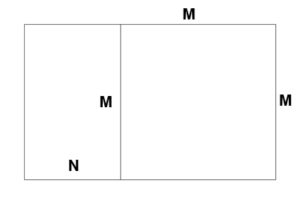
![\[ \frac{M}{N} = 1,61 \]](https://www.unopuntosei.net/wp-content/ql-cache/quicklatex.com-ce86aa7ce0a33e751c0a90d02a4023b0_l3.svg "Rendered by QuickLaTeX.com")
If we then place a square next to it, also with side M, we obtain another golden rectangle:
![\[ \frac{M+N}{M} = 1,61 \]](https://www.unopuntosei.net/wp-content/ql-cache/quicklatex.com-151fe15111787d023617acdde71e2351_l3.svg "Rendered by QuickLaTeX.com")
From this we can deduce how increasingly larger golden rectangles can be obtained.
A golden rectangle can also be constructed starting from a square using a simple compass. Pivot at the midpoint of one side and trace the curve starting from one of the vertices opposite it. Finally, project the line by joining the extension of the side on which we took the midpoint. The point of intersection gives us the measurement of the golden rectangle:

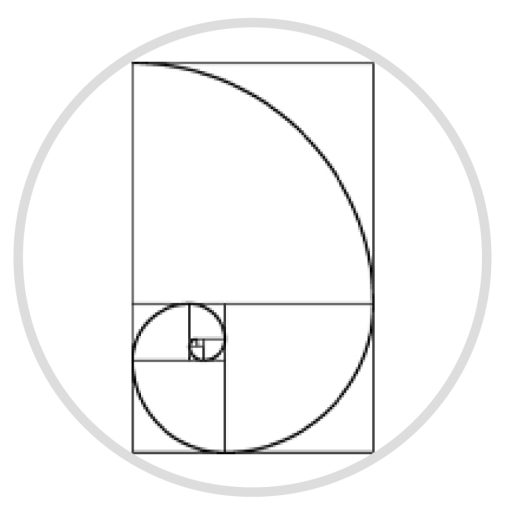
Some properties of Φ are really interesting, among these stands out the possibility of constructing increasingly smaller golden rectangles by noting that the point of intersection between the diagonals of the two rectangles is always the same and that the diagonals intersect perpendicularly:

This sequence leads to the definition of what is called a logarithmic spiral:

In 1876, the German Gustav Theodor Fechner (1801–1887), the inventor of psychometrics, conducted an experiment in which people were asked to choose their favorite from among various types of rectangles. As it turned out, the majority chose the golden rectangle. Following extensive statistical studies, he theorized that an object’s form is considered beautiful when the ratio of the larger part to the smaller part is equal to the ratio of the larger part to the whole; upon closer inspection, this is the very definition of the golden ratio.
Even without having conducted statistical studies, we find more or less the same concept in Leon Battista Alberti’s De re aedificatoria. In Chapter II of the 6th book, he expresses it as follows: “In any case, without dwelling too long, we shall define beauty as the harmony between all the parts, within the unity to which they belong, founded upon a precise law, such that nothing could be added, removed, or changed except for the worse.”
The master continues in Book 9 by introducing the definition of Concinnitas: “…Since everything that manifests in nature is regulated by the laws of Concinnitas; and nature has no stronger tendency than to ensure that all its products turn out absolutely perfect. […] Beauty is the agreement and harmony of parts in relation to a whole to which they are bound according to a specific number, outline, and position, just as Concinnitas—the fundamental and most exact law of nature—demands. Architecture follows this Concinnitas as much as possible; it is the means through which architecture achieves honor, merit, authority, and value.”
The search for such control gives a work a harmonious appearance and allows us to optimally manage the design development, starting, for example, from the simple definition of a square. From this, in a progression defined by mathematical and geometric relationships, we obtain multiple spaces described as follows: 1:2 – 1:3 – 1:√2 (the ratio between the side of a square and its diagonal), 1:4, and so on.
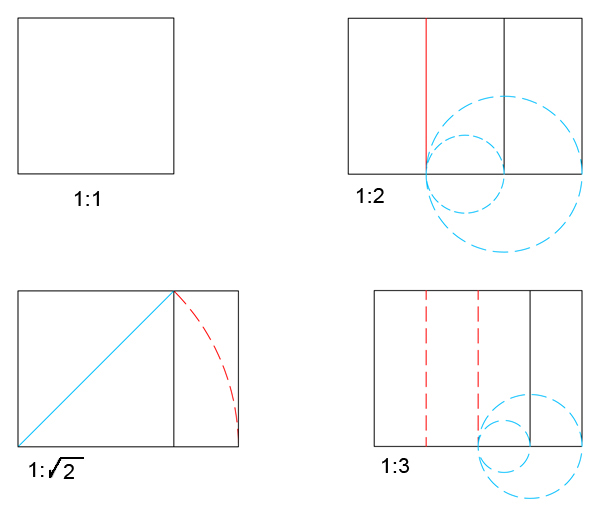
Of the many possibilities that such a medium offers us, we must succeed in achieving what Palladio describes at the beginning of his four books: “…Beauty will derive from beautiful form, and from the correspondence of the whole to its parts, of the parts to each other, and of the parts to the whole; so that buildings appear to be a complete and well-defined body, in which one member connects with another, and all the members are necessary to it.”
Here the words seem to refer to the human body, bringing to mind the Vitruvian Man, adopted by many artists, most famously Leonardo da Vinci.
But already in the Middle Ages, human measurement was used as a model.
In French cathedrals, the unit of measurement was given by five rods, these rods taking as reference the palm of the hand, the fingers, the span, the foot, and the elbow (total 5); and the sum of all the rods gave as a result the length of the human arm plus the foot.

All these quantities were multiples of a single unit called a line, corresponding to approximately 2.5 mm (2.247 mm). If we now try to use the Fibonacci sequence with the line used in the Middle Ages, we get a surprising result: 2.24 mm + 2.24 + 4.49 + 6.74 + 11.23 + 17.97 + 29.20 + 47.17 + 76.37 + 123.54 + 200….
First, let’s note that this sum gives us, in some results, the values of the palm (76 mm), the fingers (123 mm), the span, etc. And furthermore, if we divide the last result by the previous one, we obtain the golden ratio Φ = 1,61 =>
![\[ \frac{200 mm}{123 mm} = 1,61 \]](https://www.unopuntosei.net/wp-content/ql-cache/quicklatex.com-e63744d204d381ad818feb1410f3246d_l3.svg "Rendered by QuickLaTeX.com")
In practice, the human body is structured according to the golden ratio
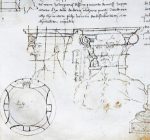 On the other hand, examples of architectural elements defined by the measurements of the human body can also be found in the drawings of proportional studies by Francesco di Giorgio Martini in his ‘Treatise on Architecture.’ The desire for control in order to create a work as harmonious as possible is linked to the dictates of nature’s measurements; this is a relationship that is indeed physical, but in my view, goes beyond physicality, incorporating and merging all aspects of correct design.
Golden proportions are also found in nature—within vegetation, such as among the leaves of an elm tree, where the ratio between the height and width of the leaf is 1.61, and in various other plants.

In the animal kingdom, insects trace a golden spiral when approaching a light source; in fact, if we want to approach a given point while maintaining the same angle of approach, this is the only way to do so. This is also what birds of prey do when hunting, ensuring they always keep their prey in sight.
What is important to understand, in my opinion, is that all architecture—whether modern or from the past—develops by adopting measurement methods inspired by nature, precisely to achieve that harmony that brings us closer to it, in a physical sense and beyond. This is a concept that will be further explored and analyzed in the second part of this article.
© Arch. Alessandro Plini
www.archihouse.it
www.plini-leone.com
Contact for projects: studioarchihouse@gmail.com o plini.leone@gmail.com
Mob. +39 3496039795
Bibliography: La sezione aurea – Mondo matematico RBA Italia ; Leon Battista Alberti – L’Architettura – Edizioni il Polifilo Milano