The Importance of Proportions and the Inconsistent Architecture of “Verticalists”: A Critique about Skyscrapers
(25-12-2018)
Understanding what, in my view, should not be done is an important first step toward reclaiming architectural design as it has developed throughout history. This involves giving ample space to reasoning that stays as close as possible to practical application, while abolishing abstruse theories that attempt to prove the unprovable or define as a “success” that which people have, in practice, rejected.
Thus, we shall reject what has been rejected, granting it no appeal now or in future discussions. We will evaluate, as rationally as possible, the characteristics that distinguish works in relation to the measurements and proportions examined in the previous article. Indeed, these can guide us in understanding how much existing architectures approach and respect what I have termed “the ways of ancient architecture.”
The “way of ancient architecture” is based on a concept intended to bring to light the contradictions of certain works—especially modern ones—by extrapolating concepts developed and defined through the direct observation of the surrounding reality. This is because the success or failure of a work is decreed by its daily lived experience, which establishes and takes root in history, rather than the original project from which it was born. In this phase, we will examine the importance of the geometric relationship as a parameter that assumes a meaning beyond simple measurements.
Beyond the values present in an artifact or a space (such as a square) of varying size—where a well-articulated analysis confirms the sensations that arouse our interest—the path of an observer toward these works finds strength in geometric relationships. It is here that a reciprocal connection manifests, in which those very measurements guide our observation.
One may be more or less expert in a subject such as this; however, even without specific knowledge to appreciate or critique the details, geometry outlines the whole. In this way, we are able to immediately perceive the object before us.
Two subjects constantly return: geometry and man. The former takes its cue from the measurements of surrounding nature and the human body (see Part 1). The latter, who inspired these concepts and their study, is utilized not only for the control of the work but also out of a need to link the existence of an artifact to the human being—to their movements, and to the eyes that seek a direction for their gaze. This encounter defines its representation in very precise terms: the geometric relationship.
This fact establishes a visible and documented concreteness, giving rise to that dualism between the subject of Architecture and the subject of Man, which finds the pinnacle of its intent in its simple but effective materiality.
The fundamental line uniting these two subjects is, therefore, the expression of a physical relationship that should always be present, but is often ignored. This is not a mere matter of measurements; it arises fundamentally from the need to ensure that, within this relationship, built elements can assimilate and be assimilated by people. It is an essential step; without it, one would have—and indeed does have—that distorted effect leading to the alienation of architectural elements and spaces. These escape our world, denying their belonging to it and assuming characteristics very different from those intended during design.
Thus, as we walk down the street, we observe the buildings around us with interest. In the immediacy of our gaze, we capture only some of the possible aspects, as our vision is by nature limited to a specific angle. To observe them in their entirety, we would have to modify our viewpoint or move further away to lengthen the perspective. From this, it follows obviously that the taller and/or longer a building is, the greater our difficulty in examining it in its totality. This physical and concrete distancing also becomes a mental one, where the relationship between man and building breaks down due to simple geometric relations.

A building is “lived” because it is close; being so, we can examine it with greater accuracy and appreciate its details. If it were very tall—as shown in the image example—observation would be more difficult. Even if we were standing right next to it, we would still find ourselves, by its very nature, in a condition of distance.
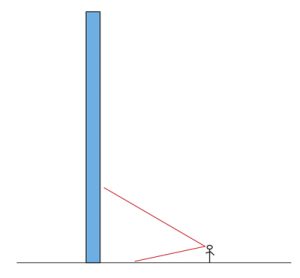 This dualism between man and building, defined by simple distance, is a parameter that helps us understand why certain structures are better appreciated over time by those who inhabit them. It is certainly not the only parameter—we will analyze others—yet it embodies the necessity of not feeling alienated in the desire to live both within and outside the walls of existing architectures.
This ambivalent and sought-after relationship elevates the previously discussed proportions to a guiding role for the entire design process, whether dealing with a single detail or the whole. This role is denied and ignored by the “fascinating” creations of skyscrapers—symbols of a power that is often confused with beauty. It is no coincidence that in their presence we feel muddled sensations that fail to take shape; a continuous contrast between the real and the ideal, where admiration meets anguish, and wonder meets our own smallness.
Everything present within them is, nevertheless, missing something, and thus eludes us; these structures, despite being so well-studied, cannot satisfy our search. This search is based on dimensional relationships. Indeed, if we move away from them to see them better, we lose them; if we approach them, they escape us because the physical dualism between man and skyscraper is absent. The aberration of all measurements fails to achieve the desired effect, which is instead shattered by objectives that are, in my judgment, deceptive.
The skyscraper expresses itself through a verticality that is overwhelmingly dominant over all other directions. In this, it manifests an intention to be imposing. New projects exalt these characteristics, and while we might judge them as “pleasant,” in practice they must be excluded from the harmonic principle of proportion between the whole and its parts.
Just as it is not enough to appreciate a painting or a fresco simply because it occupies the entire wall of a building, exaggerated verticality is not enough to exalt the aesthetic principles that form the basis of the “way of ancient architecture.” I certainly do not wish to deny the trend toward an architecture that identifies strongly with certain patterns, nor do I wish to stop the construction of these enormous containers—let them build! Rather, the goal is to make understood a relationship that, in this case, remains limited and often never truly realized.
These considerations will not be enough to halt the upward growth of one’s desires, but they may awaken minds to the awareness of their actions. Geometry—not only as a means of control but as a relationship—leads us into fundamental considerations for a deeper understanding of the subject of architecture, topics which find further development in the books of many important authors. And even if the assumption mentioned above may appear obvious, what is being produced before our eyes necessitates a greater sensitization which, though obvious, often finds no reflection in daily reality.
© Arch. Alessandro Plini
www.archihouse.it
www.plini-leone.com
Contact for projects: studioarchihouse@gmail.com o plini.leone@gmail.com
Mob. +39 3496039795