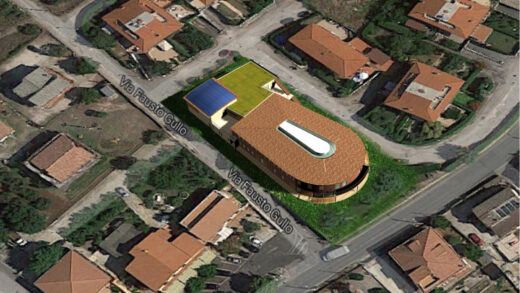
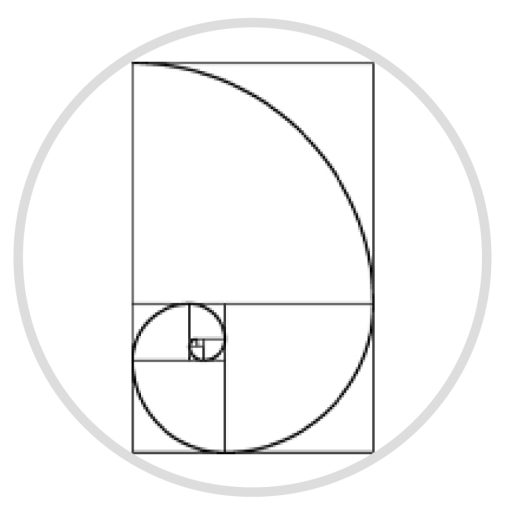
I have carried out the distribution of spaces and am now preparing to define the openings to bring light into the rooms. Roughly speaking, expressed in an extremely concise manner, this is usually the path followed when designing. This means that once the internal spaces have been drawn and the various rooms divided, we define the openings that connect these spaces to the outside. Doors and windows are often considered mere functional elements, as in contemporary architecture—especially in residential buildings—they are treated simply by following the guidelines imposed by regulations. So much so that today we find ourselves with a series of buildings where simple square or rectangular holes made in the wall define, in a way that is banal to say the least, the relationship between the exterior and interior, and between the exterior and lived experience.
Why is this? Why have we moved from representing a window or an opening by surrounding it with decorative elements of the most varied designs, to the simple depiction of a line that merely outlines the boundaries of the opening? One could say it was due to costs; however, economic necessities would a priori deny those intentions that are the very essence of making architecture. The economic necessities that lead to solving problems in a standardized way are not sufficient to justify the choices that have followed one another up to this day. Often, the search for greater cost-effectiveness seems to belong more to the factory producing the construction elements than to the architect, driving us to build everything in the same way by asserting that: “the process is faster and cheaper, to the benefit of quality.” The idea of an architecture that finds comfort in a more utilitarian view of the built environment stifles any other intention in its infancy. Faced with certain situations, even the architect sometimes finds themselves bewildered; not because it isn’t right to save money or limit costs as much as possible, but because this cannot be what guides our design. This fact is so obvious that, were it the case, we would deny the very sense of practicing architecture and would still be living in caves because they are, absolutely speaking, the cheapest option.
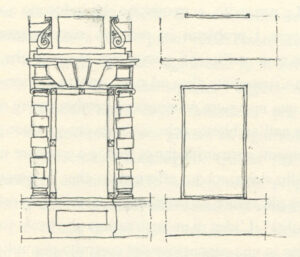
It is the so-called details that define spatiality
One could object that using a window where cost-effectiveness is pushed to the limit not only develops a focus on savings—which is always positive anyway—but above all leads to essentializing a product that, at this point, aims to be artistic. The climax of its meaning is found in the simple line that squares off the window object; the total absence of “ornaments,” rather than an economic advantage, generates meaning and represents its language. That window will emerge from the context in a total manner precisely because there will be no other distracting factors. However, as I see it, the prominence of one line—neglecting all others—will absorb the very presence of the window itself. Image becomes substance, but through a process made solely of subtractions, thereby evoking in us a feeling of total indifference, so much as to frustrate any otherwise commendable effort to achieve a result that cannot be fulfilled by the very fact of existing. In fact, what takes shape in the mind will not only fail to find confirmation in reality, but will create an opposite effect, driving the observer away from the object.
This is fundamentally because the window—or rather, the direct connection between the exterior and interior—is defined by two elements: on one side, the space occupied by the window, and on the other, the window itself. The basic concept is always the one applied to buildings; that is, space exists, and then space exists as it is worked on and interpreted by the person shaping it (mental space). Therefore, the window outlines a space, and the window itself, in its details, defines that space.
Let us take as an example the ribbon window of Le Corbusier’s Ville Savoye; we know how much this solution influenced (alas!) a large part of modern and contemporary architecture, so much so that a multitude of buildings have arisen that simply copied that model. They have contributed to designing cities made of anonymous openings intended only to respect regulatory standards, attributing an aesthetic value to them (which in many cases they lack) simply because they belong to modernist thought. In reality, Le Corbusier’s window, like many others, lacks a fundamental element. While the first element was present—namely, the occupation of a space—the second element was (and is) not: the definition of the outlined space. One might tell me that the definition of space is the occupation itself, as its linearity is itself a definition developed as the absence of decoration—let us recall in this regard the famous saying: “Less is more”. But as I mentioned earlier, by attempting to represent its definition in the line itself through a subtraction of elements, that window will no longer be a standalone element with its own expressive force, but merely a line forming part of a whole and/or an extension of other lines (for example, the volume of the villa). Architecturally speaking, it will disappear, almost as if wanting to erase itself, remaining occluded from our view and our mental space, becoming an uninteresting, boring, almost alienating element.
This window lacks the details to effectively define its space so that it can be recognized and thus become part of our mental space. The modernist line, so widely used and exalted, will distance us from it; on the contrary, it is the interplay of shapes and frames of a window in an ancient palazzo that alters space, causing us to change our perspective and producing a unique effect, even while embedded within the whole. If on one hand we have tried to deny the possibility of producing useful architecture solely on economic grounds, on the other hand we aimed, as far as possible, to make this argument valid within the poetic postulates of architecture as well. Ultimately, we cannot justify a “hole” by the need to save money, nor by the aforementioned reflections that people have been trying to teach us for a few years now. The flights of fancy of reinforced concrete or iron structures do not seem sufficient to offer us the infinite, nor can the absolute on earth lead us back to the heavens as much as the “insignificant” leaves of capitals, the “useless” lines of entablatures, and the even less visible entasis of columns. And so the question arises: should we use these elements or shouldn’t we? For now, let us begin by understanding them.
© Arch. Alessandro Plini
www.archihouse.it
www.plini-leone.com
Design Enquiries: studioarchihouse@gmail.com o plini.leone@gmail.com
Mob. +39 3496039795